
Our Forests Our Future – Yrs 9/10 Geography
-
Forest
-
Human Impacts

Excursion Program Overview
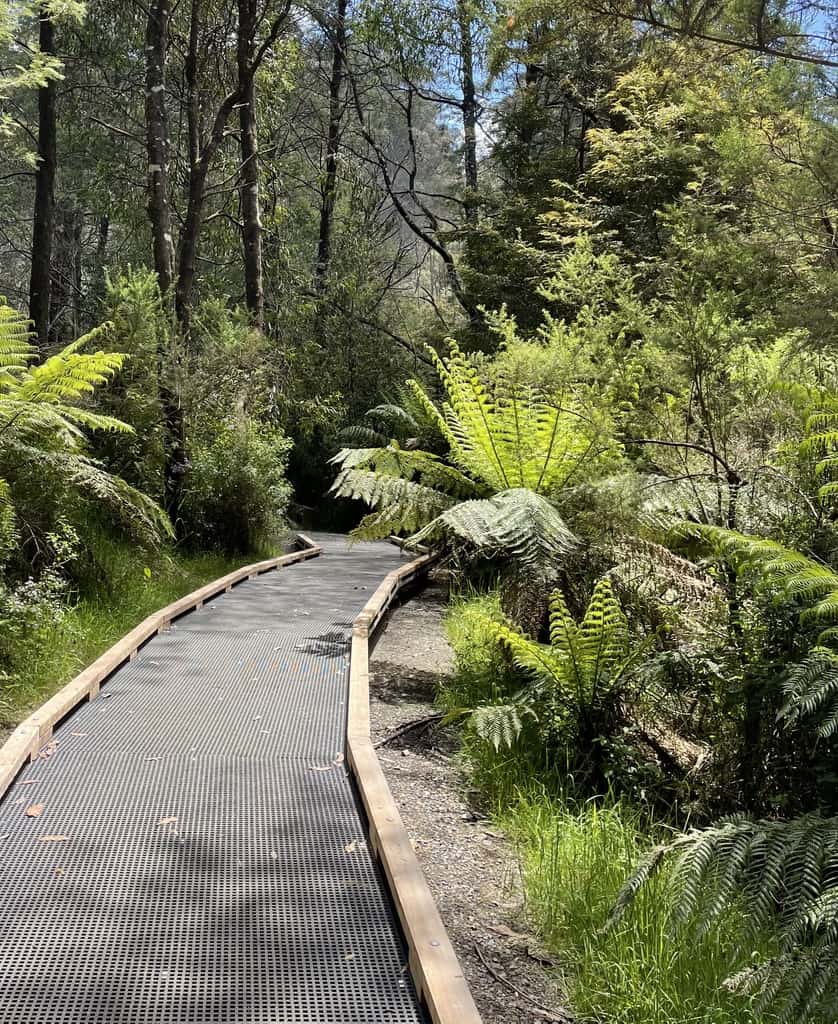
Forests are vital for our future. During this excursion, students explore the many values our forests provide and assess how they are managed to reduce human-induced change for future sustainability. As a part of the program’s emphasis on the impacts of climate change, students will perform fieldwork data collection activities related to the carbon sequestration capability of the Mountain Ash forest. We will visit a clear felled logging coupe, a protected Cool Temperate Rainforest and a Mountain Ash forest that has regenerated from the 1939 Black Friday bushfires.
This excursion program aims to ensure that students develop:
– a sense of wonder, curiosity and respect for places, environments, people and cultures throughout the world
– a deep geographical knowledge of a local forest
– an appreciation of geographical phenomena and issues, and their impact(s) on people’s lives, places and environments
– the ability to think geographically, using geographical concepts
– the capacity to be competent, critical and creative users of geographical methods and skills
– the capacity to be informed, responsible and active citizens who can contribute to the development of a world that is environmentally and economically sustainable, and socially just.
Inclusions and Notes
Equipment supplied by Gould League: Safety helmets worn by all participants; workbook and all tools required for fieldwork data collection.
Equipment needed: A chartered bus (which is required to remain with the group at all times). First aid kit , sun screen, insect repellent and PPE including hand sanitiser to kill viruses, bacteria and other micro organisations.
Please note that our Gould League educators will travel on your bus for the duration of your program time. We ask schools to ensure when booking coaches that 1 one seat is allocated for each group booked as they will provide commentary on the bus to students and guide the bus drivers. Please advise the Bookings Manager if there is no room on the coach for our educators, and travel fee of $0.88 per km will be added to your final invoice. This amount will vary according to the activities undertaken on the day which can vary due to local weather conditions. Maximum travel fee is $40. This covers the cost of one vehicle only as Gould League Educators will carpool.
Student needs to bring: Their own water and lunch, sunscreen, a clipboard, pencil, and a copy of the Gould League workbook (usually sent 14 days prior to excursion so copies can be made for students) to guide the forest investigation; bag to take away your rubbish.
Restrictions: This Gould League program is delivered in the Toolangi State Forest, in the North Central Fire District and does not operate on days with a Fire danger rating of Extreme and Catastrophic. On rare occasions, programs may be postponed due to extreme weather predictions involving wind/storms. In both cases, these programs will be rescheduled at the earliest convenience of both parties.
Programs however DO operate during wet/snowy weather. Please contact us to discuss the best timing to optimize your group’s experience and ensure suitable clothing and footwear for the conditions predicted. Plan for wet weather from April-October, and expect temperatures at least 5 degrees colder than suburban Melbourne.
Curriculum Links – Geography
Geographical Skills: Geographical Inquiry
– Interpret and evaluate information and data to make generalisations and predictions, analyse patterns and trends, infer relationships and make forecasts VC2HG10S04
– Collect, process and compare information and data from primary and secondary sources, including fieldwork and secondary research materials, using geospatial technologies and digital tools as appropriate VC2HG10S02
Geographical Skills: Concluding and Decision Making
– Consider ethical values and perspectives to justify conclusions related to a phenomenon, issue or challenge using geographical concepts VC2HG10S05
-Justify responses and develop and evaluate strategies using environmental, economic or social criteria, recommend a strategy and explain the predicted impacts VC2HG10S06
Geographical Knowledge: Environmental Change and Management
– Human-induced environmental changes and their impacts on the sustainability of places and environmental functions VC2HG10K10
Elabortions: Discussing how the source, services (including ecosystem services), sink (waste disposal) and spiritual functions of the environment can be translated into criteria for assessing sustainability ;
Identifying human-induced environmental changes (such as water and atmospheric pollution; loss of biodiversity; degradation of land and aquatic environments; and climate change) and discussing the issues they pose for sustainability;
Identifying tensions between the conflicting perspectives of individuals, communities and governments on the use of sustainable practices;
Discussing the concept of sustainability in relation to environmental functions and identifying tensions between the conflicting perspectives of communities, businesses and government
– Geographical approaches to understanding the causes and consequences of a selected environmental issue VC2HG10K11 Elaborations: Applying interconnected (holistic) thinking to examine the relationships between human actions and the biophysical processes that produce the selected environmental issue, as well as the underlying causes of those actions; Describing the impacts of the selected environmental issue on the sustainability of environmental functions
– Geographical approaches to the management of a selected environmental issue, including how environment, change, interconnection and sustainability can be considered to understand environmental issues VC2HG10K14
Elaborations: explaining the impacts or projected impacts of a selected environmental issue, such as river floods or beach erosion;
Proposing management strategies for the environmental change being investigated that are based on geographical concepts such as establishing reserves and corridors to preserve biodiversity (a spatial strategy); ecosystem-based management (an environmental strategy); environmental instead of engineering solutions (an environmental strategy); urban and transport planning to reduce energy consumption (a spatial strategy); and addressing both the underlying and immediate causes of environmental change (interconnected thinking);
Explaining how holistic thinking based on interconnections helps to identify the causes and impacts of human impacts on the environment;
Using the concept of sustainability to evaluate the significance of an environmental change:
Debating the influence of environmental worldviews, including those of Aboriginal and Torres Strait Islander Peoples, on environmental issues.
Geographical Inquiry – Geographical Skills
– Develop a range of questions for a geographical inquiry related to a phenomenon, issue or challenge VC2HG10S01
– Interpret and evaluate information and data to make generalisations and predictions, analyse patterns and trends, infer relationships and make forecasts VC2HG10S04
Geographical Knowledge – Geographies of interconnection
– The impacts of changing transportation and digital tools on peoples’ lives and places, and their interconnection with and impact on people, services and information in other places VC2HG10K05
– The impacts on places of people’s travel, recreational or cultural choices, and how these can be managed, including those impacting Aboriginal and Torres Strait Islander Peoples and their Country and Place VC2HG10K08
Elaboration: Discussing how people’s changing travel, recreational or cultural choices may affect places in the future
The Victorian Curriculum F-10 content elements are © VCAA, reproduced by permission. Victorian Curriculum F-10 elements accurate at time of publication. The VCAA does not endorse or make any warranties regarding this resource. The Victorian Curriculum F-10 and related content can be accessed directly at the VCAA website.