
5R’s of the CIRCULAR ECONOMY: Rethink, Refuse, Reduce, Reuse, Recycle
-
Global citizenship
-
Recycling and Upcycling
-
Properties of Materials
-
Design and Innovation
-
Worms, maggots & soil health
-
Sustainability and radical waste resource recovery

Program Overview
The world is full of remarkable resources — metals, glass, paper, plastics — yet many everyday items are used once and thrown away. As your educator notes explain, “we don’t have a waste or pollution problem – we have a design problem.” When products are designed to last, be repaired or remade, waste disappears and valuable materials stay in circulation.
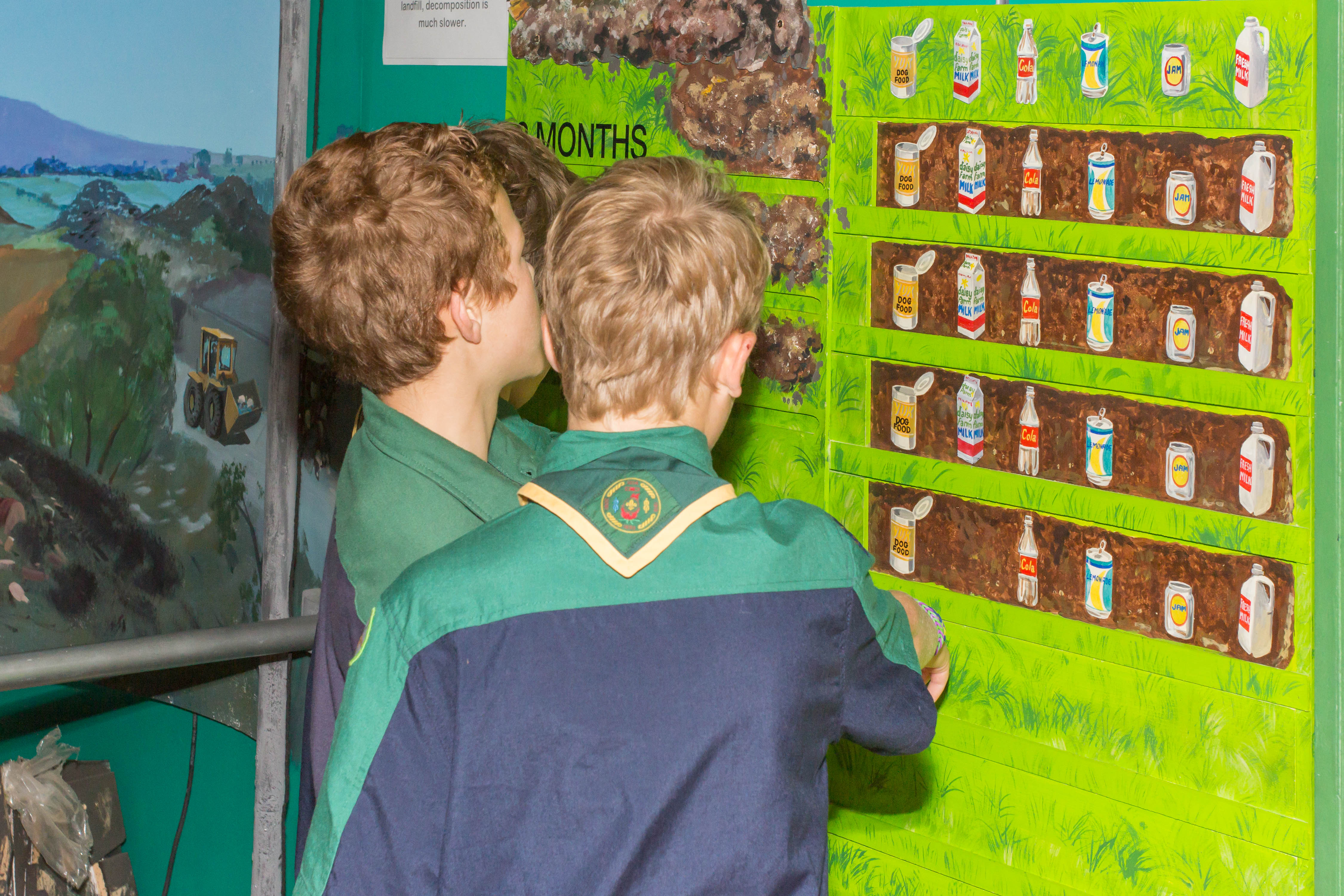
In this interactive excursion, students explore the 5Rs of a Circular Economy: Rethink, Refuse, Reduce, Reuse and Recycle. They investigate where materials come from, how products are made, and what happens when those materials are wasted. Through hands‑on sorting challenges, innovation activities and real‑world examples, students discover how smarter design and better choices can conserve resources and reduce environmental impact.
Suitable for Grades 3–6, this program builds understanding across Science, Design & Technologies, Economics & Business, and Civics & Citizenship, empowering students to become active global citizens who help protect Earth’s precious resources.
Learning Outcomes
Across the 2‑hour (3 modules) or 4‑hour (5 modules) program, students will:
- Understand the difference between a linear economy (“take–make–waste”) and a circular economy, where materials cycle continuously instead of ending up in landfill. “Heat is used in processes such as steel making… and silica to glass.”
- Learn to make informed purchasing decisions by recognising what can be recycled, upcycled, composted or must go to landfill — including complex waste streams such as e‑waste, clothing, oral care products and coffee waste.
- Explore how waste becomes a resource for innovation, from chewing gum turned into shoes and buckets to coffee grounds used to grow mushrooms or create textiles.
- Discover why natural resources are limited, what Overshoot Day represents, and how the Blue Economy, Green Economy and the 6th Wave of Innovation are reshaping industries, jobs and sustainability worldwide.
- See how science and business are designing smarter products and systems, and how students can contribute to reducing waste and conserving resources.
- Investigate the value of food waste, the importance of soil health, and how black soldier flies can upcycle scraps into sustainable protein for fish and poultry.
- Become familiar with how steel, aluminium, glass, paper and plastic are recycled, and learn about emerging alternatives such as stone paper.
At the end of the excursion, students create a Call to Action — a practical list of everyday behaviours they can share at home, school and in their community to help conserve resources and reduce waste.
Module 1 — Introduction to the 5Rs
Students explore Rethink, Refuse, Reduce, Reuse/Repurpose and Recycle, learn where everyday materials come from, and discover why product design is the key to eliminating waste. Includes the fun 5Rs dance.
Module 2 — Applying the 5Rs (Hands‑On Sorting Challenge)
A fast‑paced activity where students sort real items into recycling, upcycling, compost, soft plastics, e‑waste and landfill — learning that “waste is only waste if we waste it.” “All products can be made into something else.”
Module 3 — Recycling, Upcycling & Innovation
Students explore how the waste crisis is driving new industries, jobs and inventions. They learn about the Blue Economy, Green Economy and innovation waves, then complete a waste‑to‑product matching challenge and optional brainstorming activity.
Module 4 — Rethinking Everyday Products
Students investigate the natural resources behind common single‑use items, assess whether they can be recycled or redesigned, and explore concepts like Overshoot Day and closed‑loop production.
Module 5 — Innovation in Food Waste
Students discover the hidden value of food waste, why burning waste isn’t sustainable, and how black soldier flies can turn scraps into high‑value protein — reducing pressure on global food systems.
Module 6 (Optional) — Recover & Recycle: Steel, Aluminium, Glass, Plastic, Paper
A collaborative investigation in the Wastelands Room, where students explore how major materials are recycled and present their findings to the class.
Curriculum Links
🔬 SCIENCE – Chemical & Earth Sciences
VCSSU044 / VCSSU047 / VCSSU077
Properties and uses of materials
Reversible and irreversible changes (melting, freezing, rusting, burning)
How recycling relies on reversible changes
Earth’s resources and how they are used
VCSSU062 – Systems thinking: understanding how human use of resources affects Earth’s systems
🛠️ DESIGN & TECHNOLOGIES
VCDSTC024 / VCDSTC037
Materials, sustainability and the environmental impacts of production
Considering how design can reduce waste and improve resource use
Designing solutions that consider environmental impact
VCDSCD030 / VCDSCD031
Evaluating how products meet sustainability criteria
Exploring how products can be reused, repaired or repurposed
💰 ECONOMICS & BUSINESS
VCEBR001 / VCEBR003
Needs vs wants
Natural, human and capital resources
How societies use resources to meet present and future needs
VCEBC005
How consumer choices affect families, communities and the environment
Understanding the impact of purchasing decisions (e.g., packaging, recycling, waste)
🌏 CIVICS & CITIZENSHIP
VCCCC017
Global citizenship and sustainability
Responsibilities of citizens in caring for the environment
Understanding how actions contribute to global issues like waste and resource use
The Victorian Curriculum F-10 content elements are © VCAA, reproduced by permission. Victorian Curriculum F-10 elements accurate at time of publication. The VCAA does not endorse or make any warranties regarding this resource. The Victorian Curriculum F-10 and related content can be accessed directly at the VCAA website.