
Tidal Survival
-
Biodiversity
-
National Parks and Sanctuaries
-
Species Adaptations
-
Ecosystems
-
Human Impacts


Program Overview
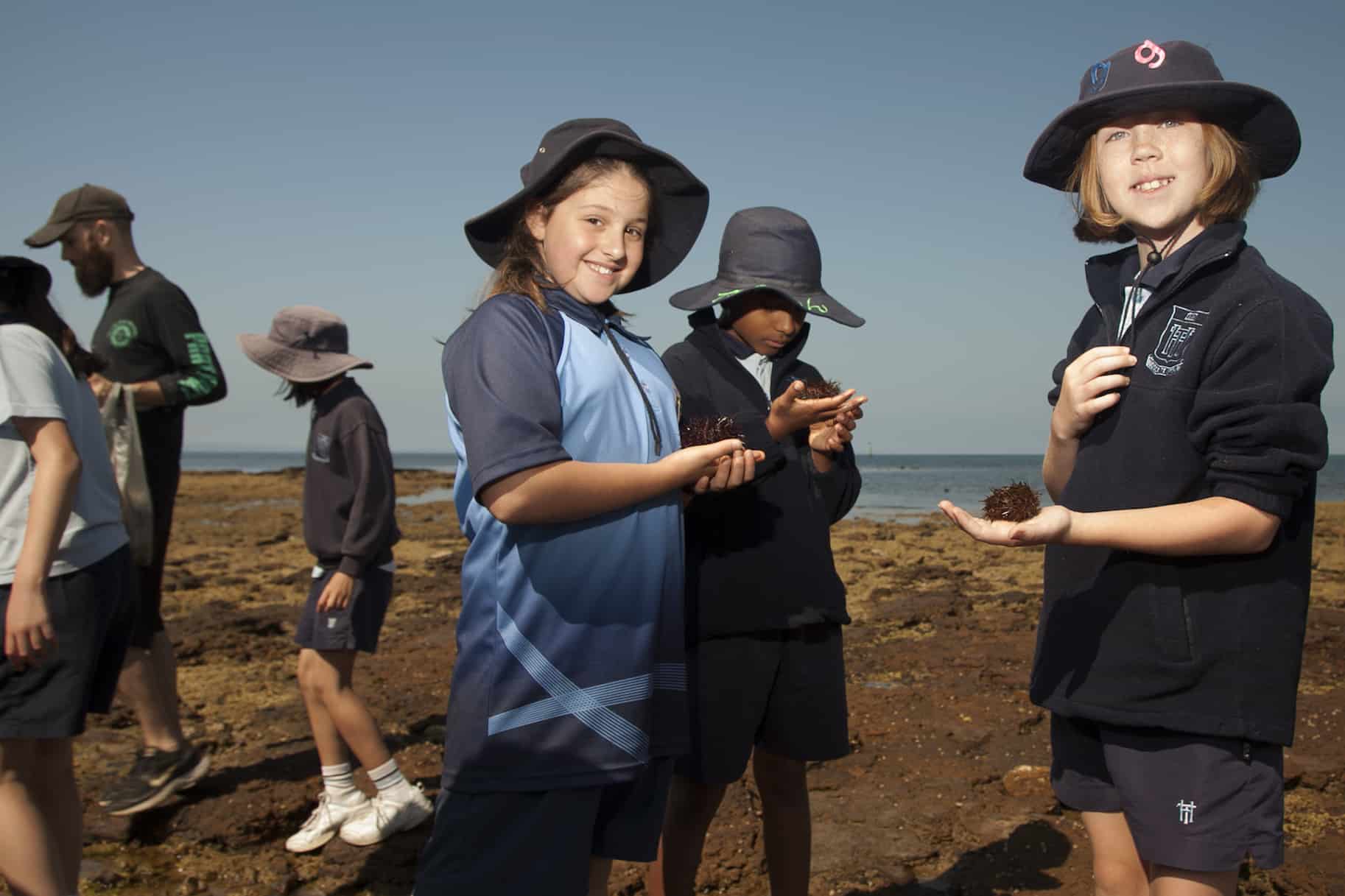
Coastal ecosystems are dynamic, harsh and full of extraordinary life. In Tidal Survival, students step into the intertidal zone at Ricketts Point Marine Sanctuary to investigate how living things survive in one of Victoria’s most challenging environments.
Across a series of hands‑on field modules, students explore structural, behavioural and physiological adaptations of marine species, conduct real ecological surveys using quadrats, observe seabirds with binoculars, and examine how physical conditions like tides, temperature and wave action shape life on the rock platform.
Students also consider their role as global citizens by examining human impacts—such as plastic pollution—and learning how communities can protect fragile coastal ecosystems.
This immersive program builds scientific inquiry skills, deepens understanding of ecological relationships, and strengthens students’ connection to Country through an understanding of Boon Wurrung land, water and custodianship.
🌟 Program Highlights
- Learning on Country at Ricketts Point Marine Sanctuary
- Field‑based scientific investigation using quadrats
- Close‑up exploration of intertidal species and their survival adaptations
- Bird observation using binoculars to study beaks, feeding strategies and behaviour
- Real‑world data collection, analysis and interpretation
- Understanding human impacts and global citizenship responsibilities
Program Options and Activities
We offer a two and a four hour program option which can be tailored to suit different levels of understanding, from topic introduction through to topic consolidation. Our two-hour program includes the first three of the activities listed below (unless you request an alternative) and a 4 hour program which includes all 5 activities. All equipment including binoculars are provided.
Features and Functions
Students will uncover the array of structural and behavioural adaptations of intertidal organisms by examining a variety of marine artefacts and specimens.
Survival in the Intertidal
By undertaking a practical investigation, students will discover how the growth and survival of organisms is dependent on the physical conditions of their environment. Students’ observational skills will be called upon to determine how the adaptations of intertidal species enable them to survive in this harsh and highly changeable environment.
Birds of the Bay
Working in groups, students will observe and identify common bird species found within the sanctuary. They will compare the different adaptations of aquatic birds’ versus those that inhabit the coastal vegetation environments. Note if birds are not numerous enough to make observations on the day, Managing Special Places will replace it in the 2 hour program.
Managing Special Places
Marine Protected Areas play a vital role in the conservation of species biodiversity. Students will discover the history behind Victoria’s Marine National Parks system and why Ricketts Point was selected as a site. The educators will lead a guided walk through the sanctuary to highlight the various management techniques used to maintain a Marine Protected Area.
Plastic Pollution
Human activities, such as littering and waste production, are having a detrimental impact on the survival of many marine species. The class will perform a marine litter audit on the foreshore to determine the most common types of debris within the sanctuary. Through group discussion, students will brainstorm how litter affects marine species and devise possible solutions to this global environmental issue.
Both programs conclude with:
Call to Action
By defining their connection to the coastal environment, students will develop everyday actions they can take to reduce their impact on the marine environment.
Certificate and Conservation Code to reinforce learnings
Post event, schools will be issued a Certificate of Participation and Conservation Code for each class which students are encouraged to sign and hang in the classroom as a reminder of their learnings and their commitment to protect the environment.
We encourage schools to connect with us a few weeks or months after school excursions to share behavioural changes made by the students or activities they have undertaken as a result of their learnings during “Tidal Survival” so we may share success stories to inspire others, monitor the ongoing impact of our programs and make relevant updates or changes if required.
Restrictions: The program is dependent on tides, therefore available dates are limited. More than four classes can be accommodated by special request, however is only available during a four-hour program.
Equipment needed: Appropriate clothing and footwear (long sleeve top, long pants, jacket, hat/beanie, soft-soled shoes e.g. runners). Students participating in the two-hour program will need to bring a snack and water. Classes undertaking the four-hour program will also need to bring lunch.
Victorian Curriculum Links
🧪 SCIENCE – Science Understanding
VC2SCU10 — Structural and behavioural adaptations of living things and how these enable survival .
VC2SCU11 — How physical conditions of environments affect the growth and survival of living things . Quadrat investigation on Neptune’s Necklace and exploration of tidal conditions.
🔍 SCIENCE – Science Inquiry Skills
VC2SCS08 — Collect, record and represent data using tables, graphs and digital tools includes quadrat counts, bird observation tables, and data recording.
VC2SCS09 — Compare data with predictions and use evidence to develop explanations ie low‑tide vs high‑tide abundance comparison.
VC2SCS10 — Communicate ideas and processes using evidence.
🧭 GEOGRAPHY – Geographical Concepts & Skills
VC2HG06 — Describe and explain interconnections within places and between places, and the effects of these interconnections.🌏 GEOGRAPHY – Geographical Knowledge
VC2HGK04 — Influence of people, including Aboriginal and Torres Strait Islander peoples, on the environmental characteristics of Australian places.
VC2HGK06 — Factors that influence people’s awareness and opinions of places – aligns with learning about marine sanctuaries, conservation messaging, and human perceptions of coastal environments.
🧭 CIVICS & CITIZENSHIP – Citizenship, Diversity & Identity
VC2CCCI04 — Examine the concept of global citizenship. Our Plastic Pollution module, sustainability discussions, and obligations to protect marine environments.
The Victorian Curriculum F-10 content elements are © VCAA, reproduced by permission. Victorian Curriculum F-10 elements accurate at time of publication. The VCAA does not endorse or make any warranties regarding this resource. The Victorian Curriculum F-10 and related content can be accessed directly at the VCAA website.