
Intertidal Food Webs and Classification
-
Biodiversity
-
Classifications
-
Food webs
-
Trophic levels
Program Overview
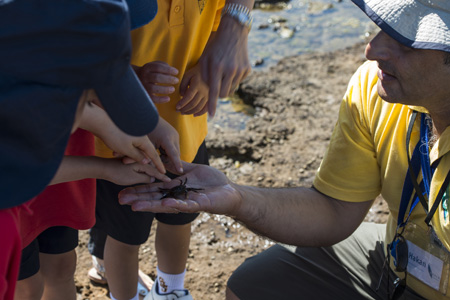
Step onto the shore and into a living laboratory. Gould League’s Intertidal Food Webs & Classification program takes Level 7–8 students beyond the classroom and into real rockpools, where they investigate marine biodiversity, food webs and human impacts on coastal ecosystems.
Students explore a local rocky shore to discover how life survives between the tides. Through guided fieldwork, they:
- Identify and classify common intertidal species using real scientific tools
- Build food chains and food webs to understand energy flow and trophic levels
- Investigate adaptations and zonation across the splash, mid‑tide and low‑tide zones
- Consider human impacts such as trampling, pollution and climate change on fragile shore ecosystems
The result is a hands‑on, inquiry‑rich experience that makes abstract science concepts concrete, memorable and relevant.
WHAT STUDENTS WILL DO
Field investigation
– Observe: Explore rockpools with educators, noticing patterns in species, habitat and tidal exposure
– Record: Use quadrats, simple transects and field sheets to collect data on abundance and distribution
– Classify: Group organisms (e.g. molluscs, crustaceans, echinoderms, algae) using observable features and keys
Food webs & ecosystem thinking
– Construct food chains and food webs using species found on site
– Identify producers, consumers and decomposers and discuss energy transfer
– Analyse “what if” scenarios (e.g. loss of a predator, pollution event) to explore ecosystem stability
Reflection & stewardship
– Discuss how science informs coastal management, marine protected areas and everyday choices
– Reflect on responsible behaviour at the shore and actions that support healthy marine ecosystems
We look forward to welcoming your students into the intertidal zone—where every rockpool tells a story about life, energy and change.
Inclusions and Notes
Restrictions: Delivery of the program is tide dependent. Please provide alternative dates that spread across at least two weeks.
Prior Knowledge required: Some understanding of trophic levels and food webs. Familiarity in the use of dichotomous keys, species identification charts and scientific nomenclature.
Equipment needed: A copy of workbook, clipboard and pencil per student. Appropriate clothing and footwear (long sleeve top, long pants, jacket, hat/beanie, soft-soled shoes e.g. runners, raincoat); Sunscreen; First Aid Kit and PPE.
Equipment supplied by Gould League: Dichotomous keys, species identification charts.
Victorian Curriculum Links
🔬 Biological Sciences (Science Understanding)
VC2S8U03 — Classification systems organise biological diversity
Students classify intertidal organisms into major taxonomic groups using observable features (e.g., molluscs, echinoderms, crustaceans). Program alignment: Rockpool species ID, dichotomous keys, structural features.
VC2S8U04 — Matter and energy flow through ecosystems; food webs model these relationships
Students construct and analyse food webs showing predator–prey relationships, trophic levels, and impacts of environmental change. Program alignment: Intertidal food webs, keystone species, human impacts (trampling, pollution).
🧪 Science Inquiry Skills
VC2S8I03 — Select and use equipment to generate and record data
Students collect field data (species counts, zonation observations) using quadrats, transects, and digital tools.
VC2S8I04 — Organise and process data using tables, graphs, keys, models
Students organise species data, construct food webs, and use classification keys.
VC2S8I05 — Analyse patterns and relationships in data
Students identify patterns in species distribution, adaptations, and food‑web stability.
🌏 Science as a Human Endeavour
VC2S8H01 — Scientific knowledge changes with new evidence
Rockpool ecology demonstrates how new marine research reshapes conservation decisions.
VC2S8H02 — Science informs solutions to contemporary issues
Links to marine sanctuary management, stormwater pollution, and biodiversity protection.
The Victorian Curriculum F-10 content elements are © VCAA, reproduced by permission. Victorian Curriculum F-10 elements accurate at time of publication. The VCAA does not endorse or make any warranties regarding this resource. The Victorian Curriculum F-10 and related content can be accessed directly at the VCAA website.