
Wood as a Resource: VCE Product Design and Technologies. Unit 3: Ethical product design and development
-
Forests
-
Human Impacts
-
Mountain Ash

Program Overview
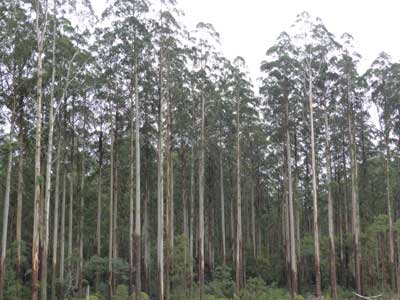
On this tour of Toolangi State Forest, learn about the forest ecosystems and how they are managed for multiple uses, including the provision of timber resources. Explore how environmental factors can affect timber quality and quantity; discuss the sustainability choices available to timber (wood, bamboo and hemp) manufacturing industries and consumers; the value of native forests and the environmental legislation that protects them; economic influences; and the impacts of logging on wildlife and endangered species.
This program also explores all aspects of sustainability in ethical product design and development:
– 6Rs: Rethink, Refuse, Reduce, Reuse, Recycle, Repair
– Triple bottom line
– Circular economy
– Cradle-to-cradle approach
– Design for Disassembly (DfD)
– Extended Producer Responsibility (EPR)
– Lifecycle analysis/assessment (LCA)
The Full Day (4 hour) program includes visitation to:
- Mountain Ash forest where native timber was previously sourced
- Clear felled logging coupe that was recently harvested
- Protected Cool Temperate Rainforest
- Endangered species habitat
Inclusions and Notes
Equipment supplied by Gould League: Safety helmets worn by all participants; workbook and all tools required for fieldwork data collection.
Equipment needed: A chartered bus (which is required to remain with the group at all times). First aid kit, sun screen, insect repellent and PPE including hand sanitiser to kill viruses, bacteria and other micro organisations.
Please note that our Gould League educators will travel on your bus for the duration of your program time. We ask schools to ensure when booking coaches that 1 one seat is allocated for each group booked as they will provide commentary on the bus to students and guide the bus drivers. Please advise the Bookings Manager if there is no room on the coach for our educators, and travel fee of $0.88 per km will be added to your final invoice. This amount will vary according to the activities undertaken on the day which can vary due to local weather conditions. Maximum travel fee is $40. This covers the cost of one vehicle only as Gould League Educators will carpool.
Student needs to bring: Their own water and lunch, sunscreen, a clipboard, pencil, and a copy of the Gould League workbook (usually sent 14 days prior to excursion so copies can be made for students) to guide the forest investigation; bag to take away your rubbish.
Restrictions: This Gould League program is delivered in the Toolangi State Forest, in the North Central Fire District and does not operate on days with a Fire danger rating of Extreme and Catastrophic. On rare occasions, programs may be postponed due to extreme weather predictions involving wind/storms. In both cases, these programs will be rescheduled at the earliest convenience of both parties.
Programs however DO operate during wet/snowy weather. Please contact us to discuss the best timing to optimize your group’s experience and ensure suitable clothing and footwear for the conditions predicted. Plan for wet weather from April-October, and expect temperatures at least 5 degrees colder than suburban Melbourne.
Curriculum Links
UNIT 3: Ethical product design and development.
Area of Study 1 – Influences on design, development and production of product
Outcome 1 – Key Knowledge: Sustainability frameworks and strategies
– 6Rs: Rethink, Refuse, Reduce, Reuse, Recycle, Repair
– Circular economy
– Cradle-to-cradle approach
– Design for Disassembly (DfD)
– Extended Producer Responsibility (EPR)
– Lifecycle analysis/assessment (LCA)
– Triple bottom line
Area of Study 3: Developing a final proof of concept for ethical production
Outcome 3 – Key Knowledge: Social, environmental, economic and worldview considerations related to selecting materials, tools and processes
FACTORS THAT INFLUENCE PRODUCT DESIGN
Product Lifecycle: The resource inputs that span a product’s manufacture; this includes sourcing of materials, useful life and the impact of disposal/reuse.
Ethical considerations in design: Ethical considerations encompass sustainability. Sustainability and other ethical considerations are concerned with human and non-human welfare and aim at positive impacts and minimisation of harm in regard to what is made and how it is made, for both present and future generations.
Sustainability: Sustainability involves actions to manage environmental, social and economic resources in such a way as to benefit present generations while not disadvantaging future generations, and generally maintaining or improving the health of these resources. – The environmental dimension is about ensuring that the resources of the planet are available for future generations and includes the selection of resources used for manufacturing and production as well as resources required for use after production. It relates to addressing the needs of a product’s lifecycle without depleting resources and/or having a lasting impact on the environment.
The economic dimension is about using resources efficiently so that economic growth continues over time. It includes the contribution of product design industries to the Australian and global economies, the creation of employment opportunities, and the costs of a product across each stage of its lifecycle. Considerations include the comparison of costs of different materials and production settings (low volume and high volume [mass-produced]) and the value that resources have today as well as their possible value in the future.
The social dimension is about ensuring that current and future generations have access to social resources such as human rights, education, political empowerment and connection to community. Social sustainability extends to stewardship that is considerate of the broad community and future generations.
VCE Study Design extracts reproduced by permission, © VCAA. VCE is a registered trademark of the VCAA. The VCAA does not endorse or make any warranties regarding this study resource. Current VCE Study Designs, past exams and related content can be accessed directly at www.vcaa.vic.edu.au